Editorial methodology
How Matchframe researches, writes and corrects its guides
Method checked 6 September 2026 · by Jay Patel, Muskan Singh and Joseph Mexatas · Editorial method
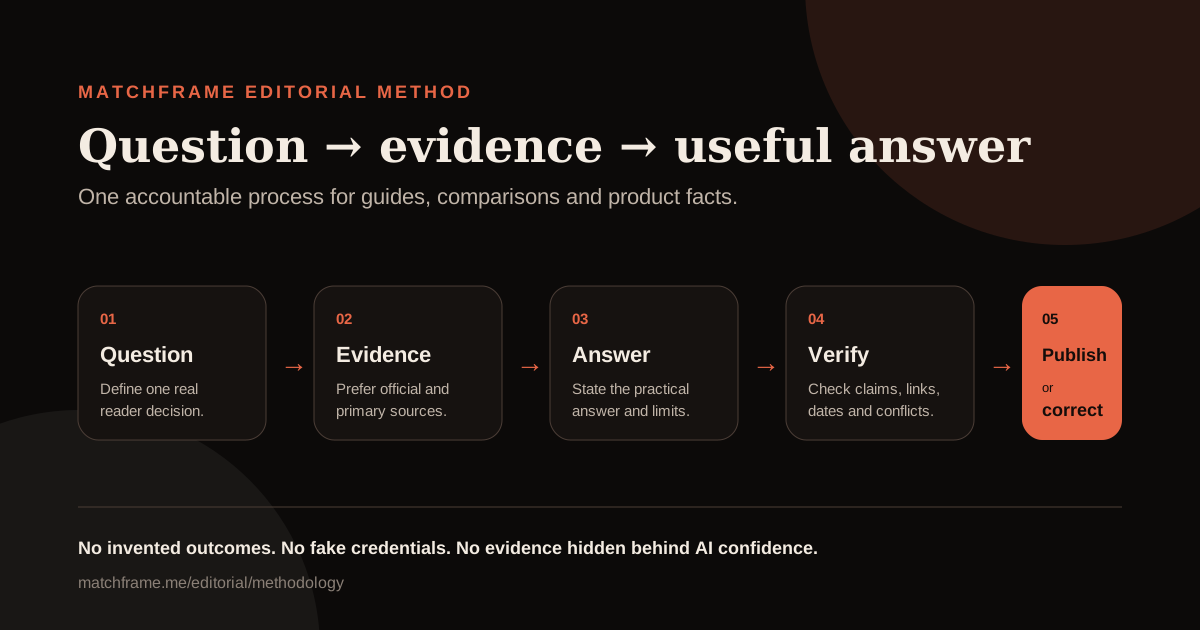
Direct answer: every Matchframe guide begins with one real reader decision, uses primary or official evidence where available, separates evidence from editorial judgment, names an accountable writer and states important limits. AI may help organise research or drafts, but it is never treated as a source.
Who is responsible for Matchframe content?
Jay Patel, Muskan Singh and Joseph Mexatas are the named writers assigned across Matchframe's guides and comparisons. Their bylines identify editorial responsibility; they do not imply qualifications that Matchframe has not verified. Matchframe, operated by Vishv Vikrambhai Odedra, is the publisher and remains accountable for corrections.
Matchframe sells the product discussed on this site. Product pages and comparisons are therefore Matchframe editorial content, not independent reviews of Matchframe. If an external reviewer later checks a specific page, that person will be named only after the review and permission to publish the attribution.
How is a page researched?
- Define one reader job. A page must help somebody choose, check, compare or fix something. A keyword alone is not a reason to publish.
- Map the claims. Prices, app rules, privacy terms, refunds and product features are separated from recommendations and clearly labelled uncertainty.
- Prefer first-party evidence. Official app help centres, company policies, product pages and original research are preferred to search snippets, copied summaries and unsourced statistics.
- Write the answer first. The useful conclusion and its limits appear near the top so a reader or answer engine can understand the page without guessing.
- Check the release. The page must have one canonical URL, crawlable HTML, a truthful title and description, working internal links, valid structured data, approved visuals and no unsupported outcome claim.
What counts as evidence?
| Evidence type | How Matchframe uses it | What it cannot prove alone |
|---|---|---|
| Official app or company page | Current public rules, features, prices or policies | A private ranking formula or individual outcome |
| Peer-reviewed or primary research | The finding, sample, date and stated limitations | That an old or narrow study applies to every current dating app |
| Matchframe product data | Clearly labelled first-party measurements with method and privacy limits | Independent validation or a guaranteed customer result |
| Editorial recommendation | A practical framework derived from visible evidence and experience | A fact published by Tinder, Bumble, Hinge or another company |
| AI output or search snippet | A lead to investigate | Evidence suitable for a published claim |
How is AI used in the editorial process?
Automation may help organise notes, compare versions, draft structure, test links and identify possible gaps. It does not become a citation, invent a credential, approve a claim or convert a competitor's statement into a fact. Material claims must remain traceable to a visible source or be labelled as Matchframe's own editorial judgment.
Matchframe does not create near-duplicate pages for every wording of the same question. When two pages would answer the same reader need, the stronger existing page should be updated or the ideas merged. This follows Google's current guidance that useful, original, people-first material matters more than producing large quantities of search-targeted pages.
How are comparisons kept fair?
Competitor facts are checked against the competitor's own current pages where possible and include a checked date. A comparison should explain who each option may suit, preserve material conditions such as renewal or refund restrictions, and avoid declaring superior photo quality without a comparable same-input test. Matchframe does not copy competitor text, images or conclusions.
How are images selected?
Editorial images must come from authorised Matchframe folders or a documented, permitted source. Captions describe what the image actually demonstrates. A generated example must not be presented as a customer result, real location, possession, activity or dating outcome. Decorative imagery does not substitute for evidence.
What will Matchframe not claim?
- No guarantee of matches, likes, replies, dates or app distribution.
- No invented percentage lift, secret algorithm rule or universal “best” pose.
- No fake customer review, independent endorsement, credential or study.
- No claim that an AI detector can prove a dating photo is authentic.
- No changed “updated” date unless the page received a material review.
How are pages updated or corrected?
Time-sensitive sources are tracked for rechecking. A visible modified date changes only when the content changes materially, not merely to make an old page look fresh. If an official source conflicts with an older Matchframe statement, the claim should be corrected, narrowed or removed.
To report an error, send the page URL and disputed statement through the contact page. Verified material errors are corrected. Matchframe does not silently turn a founder or friend comment into an independent review.
Why this method exists
- Google Search Central: creating helpful, reliable, people-first content, checked 6 September 2026; supports original value, clear authorship, transparent process and meaningful updates.
- Google Search Central: guidance about generative AI content, checked 6 September 2026; AI can support useful work, while scaled low-value output may violate spam policies.
- Google Search Central: AI search optimisation guide, checked 6 September 2026; AI visibility still depends on accessible, useful, original and well-supported web content.
- Google Search spam policies: scaled content abuse, checked 6 September 2026; quantity and automation do not excuse unoriginal pages made primarily to manipulate rankings.
Use the method, then choose the right guide
Browse source-linked answers and practical tools for improving a dating-photo set without invented promises.
Open MatchframeAlso worth reading
- Jay Patel, Matchframe writer
Author profile, evidence boundaries and corrections - Muskan Singh, Matchframe writer
Author profile, evidence boundaries and corrections - Joseph Mexatas, Matchframe writer
Author profile, evidence boundaries and corrections - AI dating photos that still look like you
What the product does, what it costs, and how to judge realism