Interactive photo-set audit
Audit your dating-profile photos: keep, repair or replace
Released 30 August 2026 · method and sources checked 8 October 2026 · download behavior checked 11 October 2026 · by Muskan Singh · Editorial method
Use this private, no-upload checklist to identify the first repair your dating-photo set needs. It checks recognition, role coverage, recency, duplication, opener clarity and truthful context, then returns branch-specific next steps. It does not score attractiveness or predict matches.
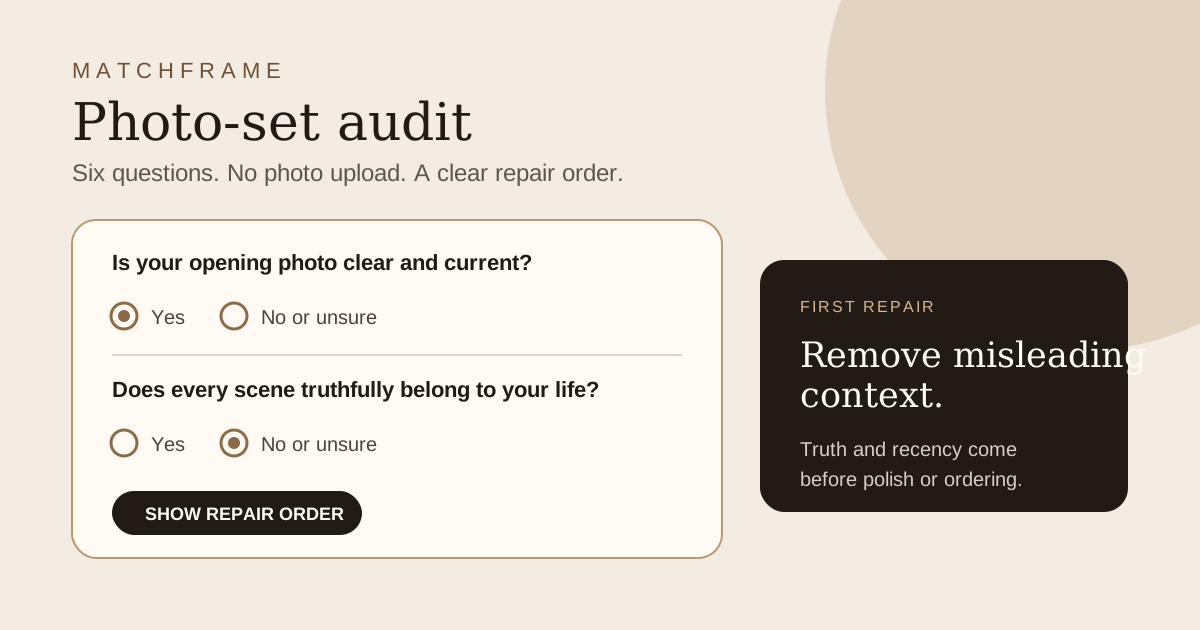
Six-question photo audit
No face or image is uploaded. Choose the answer that best describes the set currently on your profile.
Copying and downloading are user-initiated and happen in this browser. Sharing sends only this page link, never your answers.
Why the order matters
An unclear opener is a larger usability failure than a missing dressed-up photo. A false or outdated image is a trust problem, not a styling problem. The audit therefore treats identity, truth and recency as stop conditions. It moves to variety only after those pass. This keeps small cosmetic edits from hiding a more important replacement.
The complete decision tree
Method version 1.0. The audit uses six fixed rules, not AI, facial analysis or a hidden attractiveness score. It checks failures in the order shown below and returns at most the first three repairs so the plan remains usable. A pass means only that the set cleared this basic rule. Reviewers can inspect or download the same method as JSON, or download the six-rule method as CSV.
| Order | Rule that passes | Action when it fails |
|---|---|---|
| 1. Opener | Current solo photo with a clearly readable face | Replace the opener first |
| 2. Truth | People, pets, places and activities truthfully belong to your life | Remove misleading context |
| 3. Recency | Every posted photo still matches your current appearance | Replace outdated photos |
| 4. Duplication | No two frames repeat nearly the same crop, outfit and role | Remove the weaker duplicate |
| 5. Body context | At least one current full-body photo is present | Add body context |
| 6. Everyday context | At least one real activity or everyday setting is present | Add one honest conversation route |
The order is deterministic: opener, truth and recency protect recognition and trust; duplication, body context and everyday context improve range after those basics pass. The tool applies no outcome weights because Matchframe has not validated these rules against match or date outcomes.
What “keep” means
Keep a photo when it is current, recognisable, technically usable and does a job no other frame already does. A keep decision is not a claim that the image is universally attractive. It means the frame contributes distinct, truthful information: identity, body context, everyday life, an activity, community or range.
What “repair” means
Repair only when the underlying moment is truthful and useful. A slightly tight crop, weak exposure or distracting colour can be adjusted without changing the person or event. Preserve the original file and make a new export. If the face is blurred, the frame is years old or the context is false, editing cannot make it trustworthy; replace it.
What “replace” means
Replace an unclear opener, an outdated appearance, a repeated selfie, an unreadable group frame or any scene that creates a false impression. Use the solo capture guide or the friend-shoot plan to create the missing role deliberately.
What this audit cannot tell you
It cannot see account distribution, location, preferences, prompts, messaging or app-side experiments. It cannot diagnose why a particular person did not respond. If your photographs pass but the account is quiet, use the no-matches diagnosis to separate profile presentation from non-photo causes.
How the rubric was built
The branches combine current public app guidance with Matchframe's disclosed editorial role system. Bumble's optional photo-feedback examples cover variety, blur, repeated images, solo and group frames, sunglasses, selfies, activities and the first-photo choice. Hinge recommends a complete profile with varied photos and prompts. The rubric turns those public principles into a fixed repair workflow; it is not a validated scientific score and carries no outcome weighting.
How this no-upload audit differs from app photo feedback
| Tool or guidance | What it uses | What the public source establishes |
|---|---|---|
| Matchframe photo audit | Your six answers, processed only in this browser | No image upload, face analysis, answer storage or answer transmission |
| Bumble photo feedback | Profile photos only after the member chooses Get feedback | Bumble says it looks for general, non-sensitive visual elements rather than identity, faces or sensitive traits; Google Cloud processes the images and deletes them after feedback is provided |
| Hinge profile guidance | General public advice rather than an image submitted to this Matchframe tool | Suggestions about varied photos, prompts, preferences and Likes; not a disclosed image-scoring or ranking system |
This comparison is deliberately narrow. It describes only the linked public pages and does not claim to cover every Bumble or Hinge data flow. Matchframe does not reproduce either app's private model, ranking system or account data.
Privacy and release status
Version one does not request or transmit images. Matchframe does not send the six answers to a server or save them in local storage. Copying or downloading a repair plan is an explicit browser action; sharing sends only the canonical tool link and never includes an answer. Before release, the empty state, both result paths, branch order, copying, downloading, sharing, mobile layout and analytics boundary were checked. The tool remains a decision aid: it does not inspect a face, attractiveness, account distribution or dating outcomes.
Sources and method
- Bumble: Providing feedback on your photos, updated and checked 8 October 2026.
- Hinge: Why aren't I getting any matches?, updated 27 July 2026 and checked 8 October 2026.
- White, Sutherland and Burton: Choosing face, open-access profile-image selection research checked 8 October 2026.
Frequently asked questions
Does the audit upload my photos?
No. Version one asks six descriptive questions and runs entirely in the browser without requesting a face or image.
Can this score predict matches?
No. It checks opener clarity, role coverage, recency, duplication and truthful context; it cannot predict app distribution or individual behavior.
What should I fix first?
Replace an unclear opener or misleading or outdated photo before improving variety, styling or order.
Need to replace the missing roles?
Use the audit result to brief a real shoot or screen a Matchframe pack. No score guarantees matches.
Open MatchframeAlso worth reading
- How Matchframe researches and checks its guides
Evidence rules, AI assistance, comparisons, updates and corrections - Jay Patel, Matchframe writer
Author profile, evidence boundaries and corrections - Muskan Singh, Matchframe writer
Author profile, evidence boundaries and corrections - Joseph Mexatas, Matchframe writer
Author profile, evidence boundaries and corrections