Practical photo guide
Dating profile photo poses for men: a natural shot plan
Guidance and sources checked 4 September 2026 · by Muskan Singh · Editorial method
Quick answer. There is no proven universal best dating-profile pose. Start with an open, comfortable stance; give one hand or the whole body a small real action; keep the face readable; and photograph the same setup with two or three eye lines. A strong profile then varies the framing, action and context instead of repeating one polished stance.
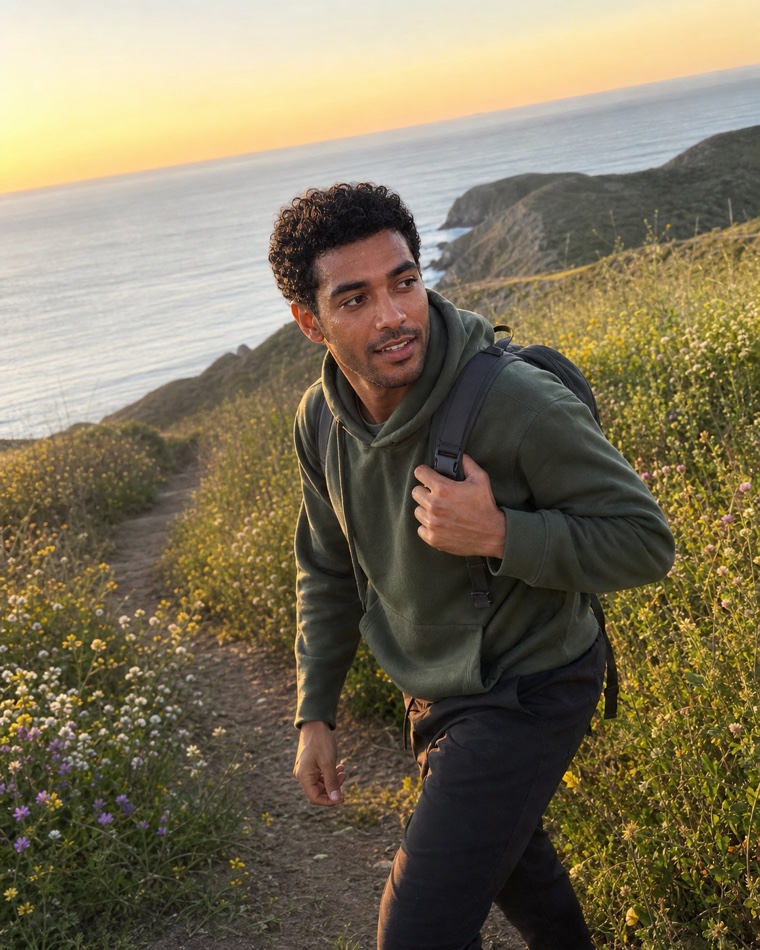
Use the four-part pose cue
When someone says “pose naturally,” the direction is too vague to be useful. Use this four-part pose cue instead: frame role + stance + action + eye line. Decide all four before taking the photograph.
- Frame role: Is this the clear opener, a full-length view, an everyday context, an activity or a supporting expression?
- Stance: Square, slightly turned, walking or seated. Choose the position that feels stable and comfortable for your body.
- Action: Rest a hand, take one step, adjust a sleeve, turn a page or continue a real activity. Use only one action at a time.
- Eye line: Look into the lens, towards the person taking the photo or at the real task. Do not look randomly into empty space.
The system separates decisions, which makes a stiff frame easier to diagnose. If your expression is natural but the body feels staged, keep the expression and change only the stance. If the hands look awkward, keep the body position and give one hand a simple job.
Start with a clear first-photo pose
The opener has a different job from a fashion portrait. It should make your face easy to recognise at a small size. Frame from roughly mid-chest to just above the head. Stand or sit comfortably, keep both shoulders visible, and look into the lens. A relaxed mouth or a real small smile can both work; the important point is that the expression is current and recognisable.
Take one square-to-camera version and one version with the torso turned only as far as remains comfortable. Do not treat 20 degrees, 45 degrees or any other number as a rule. Body proportions, clothing, mobility and the camera position all change how an angle reads. Compare the two photographs after cropping them to the same app-sized card.
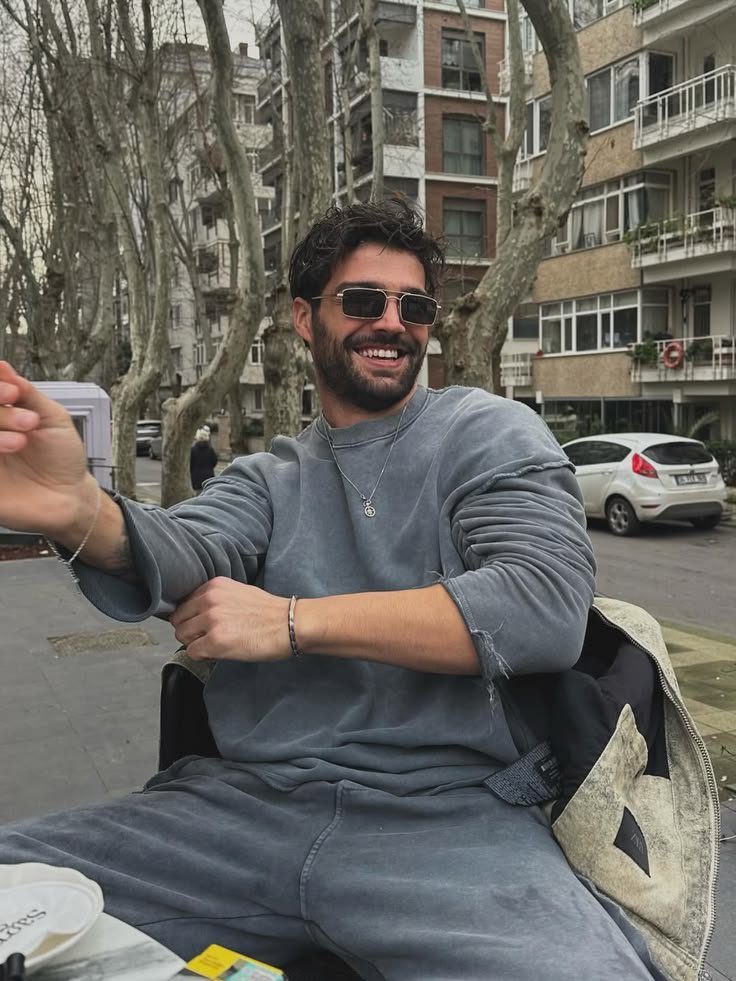
Eight natural pose recipes
These are starting positions, not personality templates. Keep the recipe that looks like you and discard the rest.
| Photo job | Stance and hands | Eye line and capture cue |
|---|---|---|
| Clear opener | Comfortable upright stance; arms loose or one hand lightly resting | Eyes to lens; make one small expression change between frames |
| Three-quarter portrait | Turn the torso a little, then bring the face back without twisting | Lens first, then the photographer beside it |
| Full-length frame | Stand evenly or shift weight naturally; keep feet visible | Pause, then take one step towards a marked spot |
| Walking frame | Walk a short repeatable path with normal arm movement | Look where you are going, then towards the photographer on the last step |
| Seated portrait | Both feet supported; one forearm resting lightly; spine comfortable | Eyes to lens, then react to a real question |
| Cafe or table frame | One hand on the cup or table; the other relaxed and visible when practical | Look at the person opposite you, not down at the prop in every frame |
| Real activity | Let the task determine the body position; do not freeze mid-performance | Focus on the task, then make one brief glance to camera |
| Supporting close-up | Stable position with no extra prop | Use a different genuine expression from the opener, not a staged laugh |
Do not use all eight. The table is a shooting menu. Your final profile needs different jobs, not eight versions of the same day. See the complete dating-profile photo guide for deciding which roles belong in the finished set.
What should you do with your hands?
Hands look awkward when they have no reason to be where they are. Give one hand a light, believable job and let the other rest naturally. Suitable jobs include holding a cup by the handle, turning a page, adjusting a cuff, touching the back of a chair or continuing a real activity. Avoid squeezing the object or repeating the same pocket pose in every photograph.
A prop should explain the scene. It should not invent your life. Do not borrow a dog, musical instrument, motorcycle, luxury object or sports kit only to imply an interest you do not have. If no honest prop belongs in the scene, photograph the opener without one.
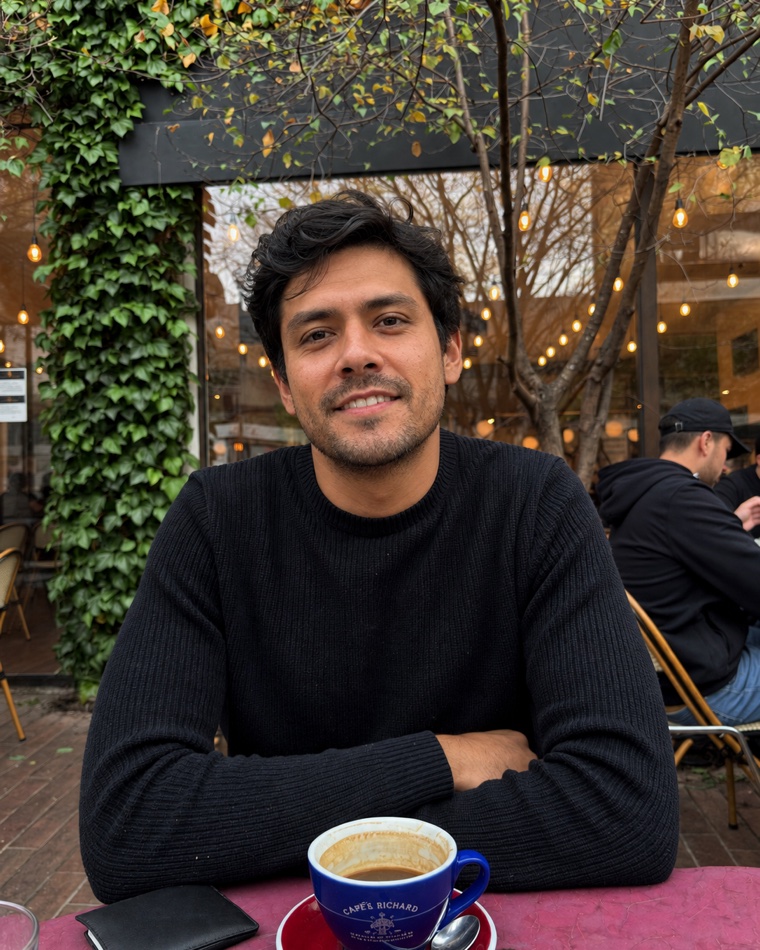
How should you stand, sit or move?
Standing
Start from a stable neutral stance. Lengthen the spine without pushing the chest forward. Let the shoulders settle after an exhale. If shifting weight feels natural, move it slightly and soften the other knee. If it does not, keep your weight even. The aim is comfort and control, not a prescribed silhouette.
Sitting
Choose a chair that supports you. Keep the camera around face level rather than low near the knees. You can sit near the front of the chair and lean slightly from the hips, or sit fully supported if that is more comfortable. Resting one forearm lightly can give the hand a place without closing the body.
Moving
Mark a safe path of three to five steps. Walk at your normal pace while the photographer uses burst mode. Repeat the same path, changing only the eye line on the second pass. Running, jumping or exaggerated turning usually creates more variables than the frame needs.
Adapt the pose to your body and mobility
A natural pose is one you can hold or repeat safely. A seated opener can be as clear as a standing one. Wheelchairs, canes, crutches, prostheses and other mobility devices should not be hidden or digitally removed. Place the camera where your face and posture read clearly, keep the device positioned as you actually use it, and choose gestures that do not compromise balance or comfort.
If turning, leaning or walking is painful, skip it. Use eye line, hand placement and expression to create variety instead. The photographer should ask before moving a device or offering physical assistance. Stop the sequence if a position causes strain, dizziness or instability.
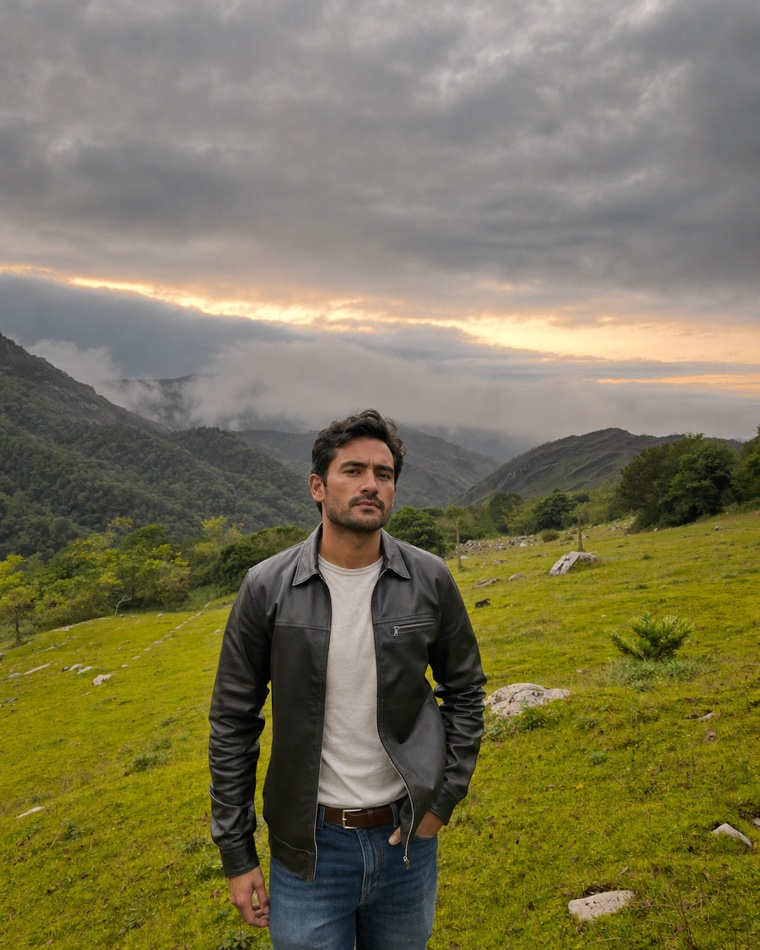
What does the posture research actually show?
A 2016 PNAS paper studied expansive and contracted nonverbal displays at first meeting. Its dating-app experiment was a small, six-confederate profile test in the San Francisco Bay Area. The researchers created 12 profiles and analysed 2,983 eligible exposures. Expansive profiles received 447 of 820 positive responses; the reported odds ratio was 1.27, with a 95% confidence interval from 1.08 to 1.49.
That result is often turned into an advertising statistic, but the limits matter. The male subgroup produced only 30 positive responses, 26 on expansive profiles. The authors called gender interpretation tentative because confederate identity and gender were confounded. The study was conducted in 2016, involved heterosexual US participants and did not measure current app distribution, conversations, dates or relationships.
The responsible takeaway is narrow: avoid making every frame look physically contracted if a comfortable open position is available. It is not a current-platform ranking formula, a promise of a 27% lift or evidence that a particular torso angle works for every man.
Run a controlled 24-frame pose sequence
More random photographs do not automatically produce a better result. Use four photo roles and take six frames for each role: a clear opener, a full-length frame, a seated or everyday frame, and a real activity or movement frame. That creates a 24-frame contact sheet that is varied enough to compare without becoming chaotic.
- Frames 1 and 2: hold the starting position and change only the eye line.
- Frames 3 and 4: add one small hand or body action while the camera runs in burst mode.
- Frames 5 and 6: let the photographer ask a real question and capture the response before resetting.
Review after each six-frame block. If all six fail for the same reason, change one variable before continuing. Raise the camera if the perspective is the problem; remove the prop if the hands are busy; simplify the direction if the expression is forced. For timer, distance and lens setup, use the guide to taking dating-profile photos alone.
Judge the pose at dating-app size
A pose can look elegant full-screen but unclear in a small profile card. Make a temporary crop for the app you use and view it at roughly phone-card size. Check four things: can you recognise the face, can you understand the body position, is the hand or prop cut awkwardly, and is this frame visibly different from the others?
Compare similar frames side by side without beauty filters. Keep the one that is easier to understand, not automatically the one with the most dramatic pose. Ask one trusted person, “Which photo looks most like me in person?” That is an identity check, not a testimonial or proof of dating results.
Build variety without looking inconsistent
Tinder's current Photo Tips evaluates variety across activities, settings and poses and flags sets that are too similar. Hinge's current profile guidance says members need four to six photos depending on local requirements. Those facts do not mean every slot needs a new personality.
Keep identity cues consistent while changing the photo job. Your hair, facial hair, body shape and everyday style should still represent the same current person. Vary one or two visible dimensions at a time: close versus full length, still versus moving, lens eye line versus task eye line, indoors versus outdoors. Do not use six different AI scenes to manufacture a life that cannot be recognised in person.
Pose mistakes to fix before publishing
- Same pose in every slot: change the photo job, not just the background.
- Both hands hidden every time: give one hand a visible, light job in a supporting frame.
- Forced laugh: ask a real question and capture the response instead of holding an open-mouth smile.
- Low camera angle: move the camera towards face level unless the unusual perspective is intentional and still recognisable.
- Fashion pose without context: return to a stable stance and one action that belongs in the scene.
- Unsafe or uncomfortable position: stop and adapt the pose; comfort is a release requirement.
- Invented AI body language: reject a generated frame if it changes your body, mobility, activity or physical ability.
Final pose release checklist
- The opener makes your current face clear at app-card size.
- Every selected photo has a defined role.
- The set varies framing, action or eye line instead of repeating one stance.
- Hands and props make sense in the real setting.
- No pose causes pain, instability or strain.
- No pet, hobby, location, luxury cue or mobility detail has been invented.
- Your body proportions and recognisable features remain accurate.
- The final crop does not cut joints or meaningful props awkwardly.
- A trusted person can still recognise you across the whole set.
After the pose passes, check the dating-photo outfit guide and the profile-photo crop guide. Pose, clothing and crop solve different problems; do not use one to hide a failure in another.
Sources and limitations
- Vacharkulksemsuk et al., PNAS (2016), full paper checked 4 September 2026. The app experiment used six confederates and 2,983 eligible exposures; it is not a current ranking study or an individual outcome promise.
- Tinder Photo Tips, updated 26 August 2026 and checked 4 September 2026. Used for current set-variety guidance, not a pose performance claim.
- Hinge profile editing guidance, updated 28 July 2026 and checked 4 September 2026. Used for Hinge's current four-to-six-photo requirement, not a universal ideal.
- Hinge Convo Starters, updated 7 August 2026 and checked 4 September 2026. It shows how contextual profile content can inspire a suggestion; it does not prove more conversations.
- Bumble photo feedback, updated 3 September 2026 and checked 4 September 2026. Used for current clarity and variety checks, not a ranking formula.
Frequently asked questions
What is the best dating profile pose for a man?
There is no proven universal best pose. For a clear opener, use a comfortable open stance, keep the face easy to recognise, look into the lens and take both a square and a slightly turned version for comparison at app-card size.
What should a man do with his hands in photos?
Give one hand a light, believable job, such as holding a cup, turning a page or resting on a chair. Keep the other relaxed when practical, and do not repeat the same pocket pose in every photograph.
Should I smile in every dating profile photo?
No. Use at least one clear, current expression, then vary the set with a smaller smile, a focused activity or a genuine reaction. Every expression should remain recognisably you.
How can I look less stiff in dating photos?
Use one small action instead of holding a static pose. Take a step, adjust a sleeve, turn a page or answer a real question while the photographer uses burst mode. Change one variable at a time.
Can I use a seated pose as my first photo?
Yes. A seated opener can work when the camera is near face level, your posture is comfortable and supported, and your face remains clear after the app crop.
How many pose variations should I photograph?
Try four photo roles with six frames each: two eye lines, two small-action frames and two reaction frames. Review each block before changing the camera or pose.
Do dating apps reward open body language?
No current official source reviewed here publishes an open-posture ranking rule. A limited 2016 experiment found more positive responses for expansive profiles, but it does not establish a current app algorithm or guarantee matches.
Can AI change my pose for a dating photo?
Only keep a generated pose if it preserves your real body, mobility and plausible physical ability. Reject frames that invent a hobby, pet, place, luxury cue or movement you could not honestly reproduce.
Need a full set that still looks like one person?
Matchframe builds varied dating-photo scenes from one current identity; you screen the final set for consistency.
Open MatchframeAlso worth reading
- What men should wear in dating profile pictures
A four-test system for truthful, clear outfit choices - Tinder profile photos for men
Current Tinder tools, opener checks and flexible photo roles - Hinge profile photos for men
Four to six roles, prompt pairing, Top Photo and truth checks - Bumble profile photos for men
Four to six roles, Best Photo limits, prompts and truth checks