First-photo guide
Best first dating-app photo for men: a two-stage chooser
The best first dating-app photo is usually a current solo portrait that makes you immediately recognisable on a phone screen. Your face should be clear, the crop should leave safe space around your head, and the scene should be truthful. Choose for recognition first; use later photos for hobbies, friends, travel and status.
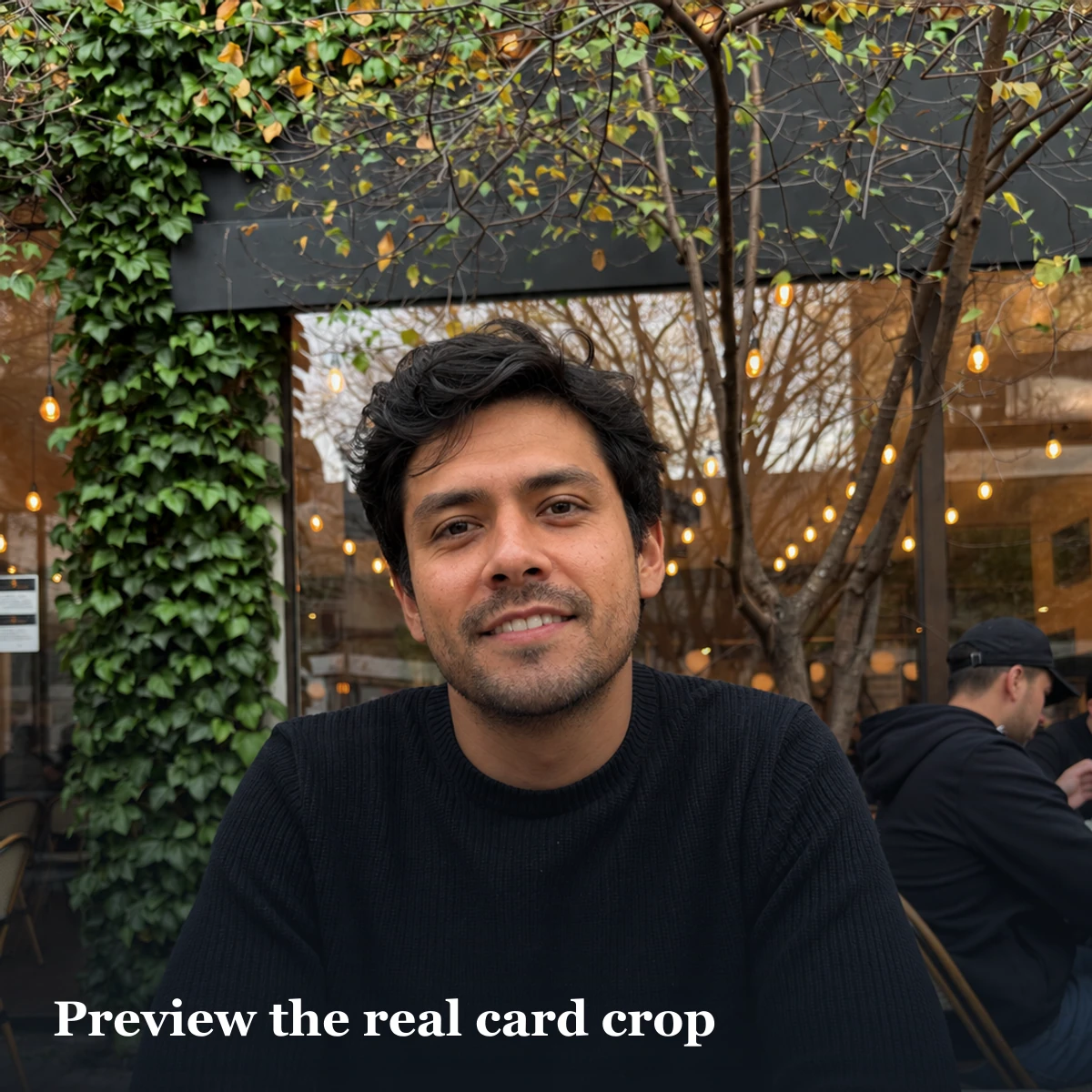
Five gates, then one pairwise choice
Decision rule: one failed gate removes the candidate. Ask an independent selector which surviving image looks most recognisably like you today. This is an editorial chooser, not a match prediction.
Stage one: reject any photo that fails a gate
A score can hide a serious failure. An outdated photo should not earn its way back by having good light, and a group shot should not pass because the background looks interesting. Apply these five yes-or-no gates before discussing style.
| Gate | Pass | Reject or recapture when |
|---|---|---|
| Current | It represents your face, hair, beard and body now | A date would meet a materially different appearance |
| Solo identity | A stranger knows which person owns the profile | Another person, mask, helmet or distance creates doubt |
| Readable face | Eyes and main facial features survive card size | Blur, deep shadow, sunglasses or a tight crop hides them |
| Truthful scene | You can explain the place, clothing and activity honestly | The frame invents a lifestyle, event or body you do not have |
| Crop safe | Head, chin and useful context stay clear in the app preview | The app crop cuts important detail or makes the face too small |
A failure in recency or truth means replace the image. A good real moment with only a framing or exposure problem may be worth recapturing or making a modest technical edit. The dating-photo crop guide explains that narrower repair boundary.
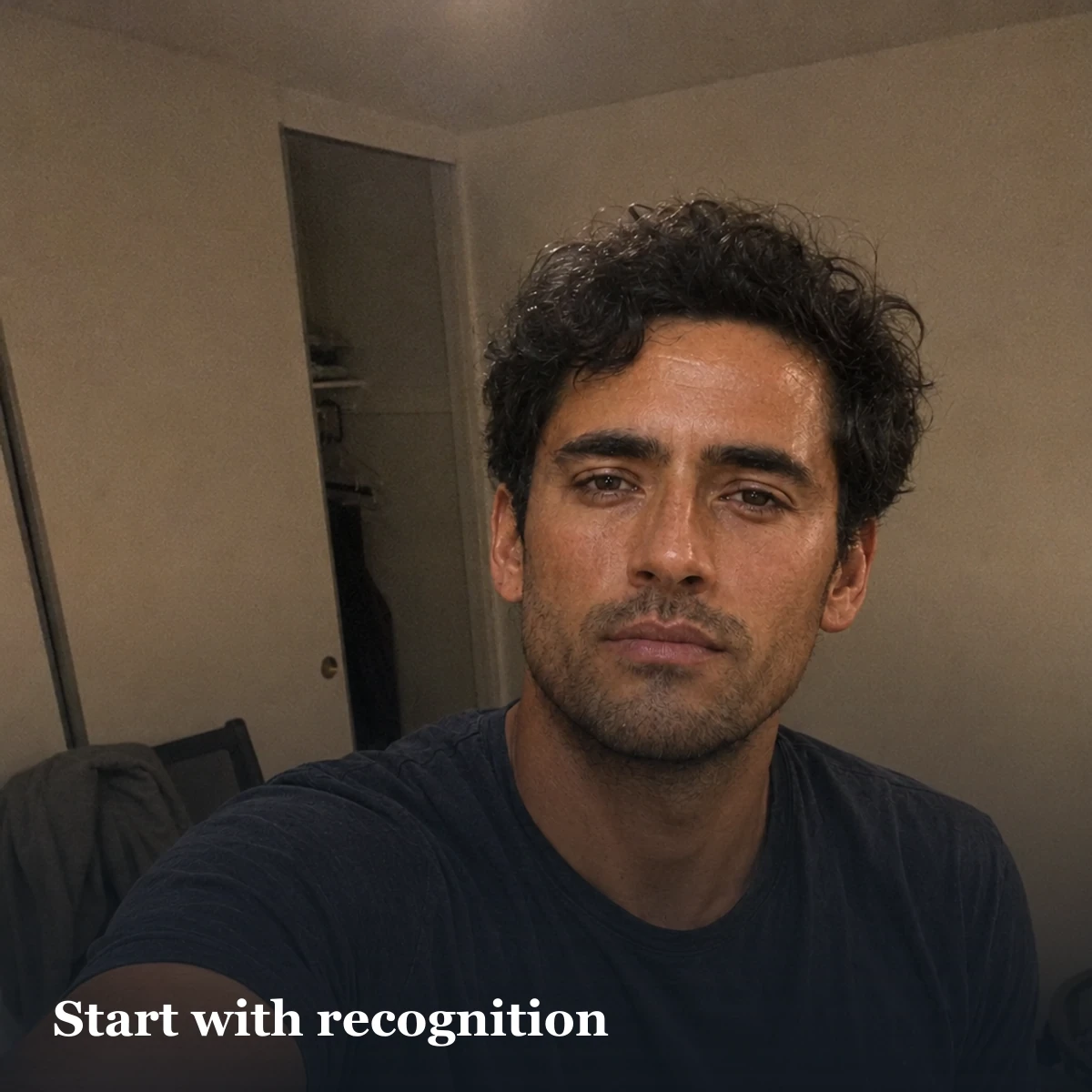
Stage two: choose between the survivors
Make every remaining candidate the same width on a phone or contact sheet. Do not zoom. Compare two at a time and ask one narrow question: which photo makes the current person easiest to recognise? Keep the winner, compare it with the next candidate, and repeat until one remains.
- Preview the real crop. Use the app's edit screen rather than judging the full camera file.
- Hold size constant. A larger preview will make almost any image feel clearer.
- Prefer calm separation. The face should remain the first subject without erasing truthful context.
- Use natural expression as a tiebreaker. Do not force a smile or choose by one universal expression rule.
- Ask an independent selector. Show only the finalists and ask which looks most recognisably like you today.
This pairwise method deliberately avoids a made-up points total. It cannot predict likes or matches; it makes the selection rule visible and prevents a pretty background from compensating for an identity failure.
What Tinder, Hinge and Bumble tools actually do
Current app features support careful selection, but none publishes a universal first-photo formula. Tinder says its on-device Photo Selector suggests camera-roll images using elements such as lighting and composition, filters out group photos, and leaves the upload decision to the member. Hinge says Top Photo uses a model to predict which uploaded photo is most likely to receive a Like and may keep testing and reordering the set. Bumble says Best Photo puts the most popular uploaded image first; its separate, currently tested photo-feedback feature gives private advisory prompts about issues such as a group opener, blur, duplication or sunglasses.
Use those tools after every candidate passes truth, recency and recognition. Automated ordering can compare the files you upload; it cannot repair missing identity evidence, confirm that a generated scene happened or make an old image current. Product descriptions also do not disclose the complete ranking systems used to distribute profiles.
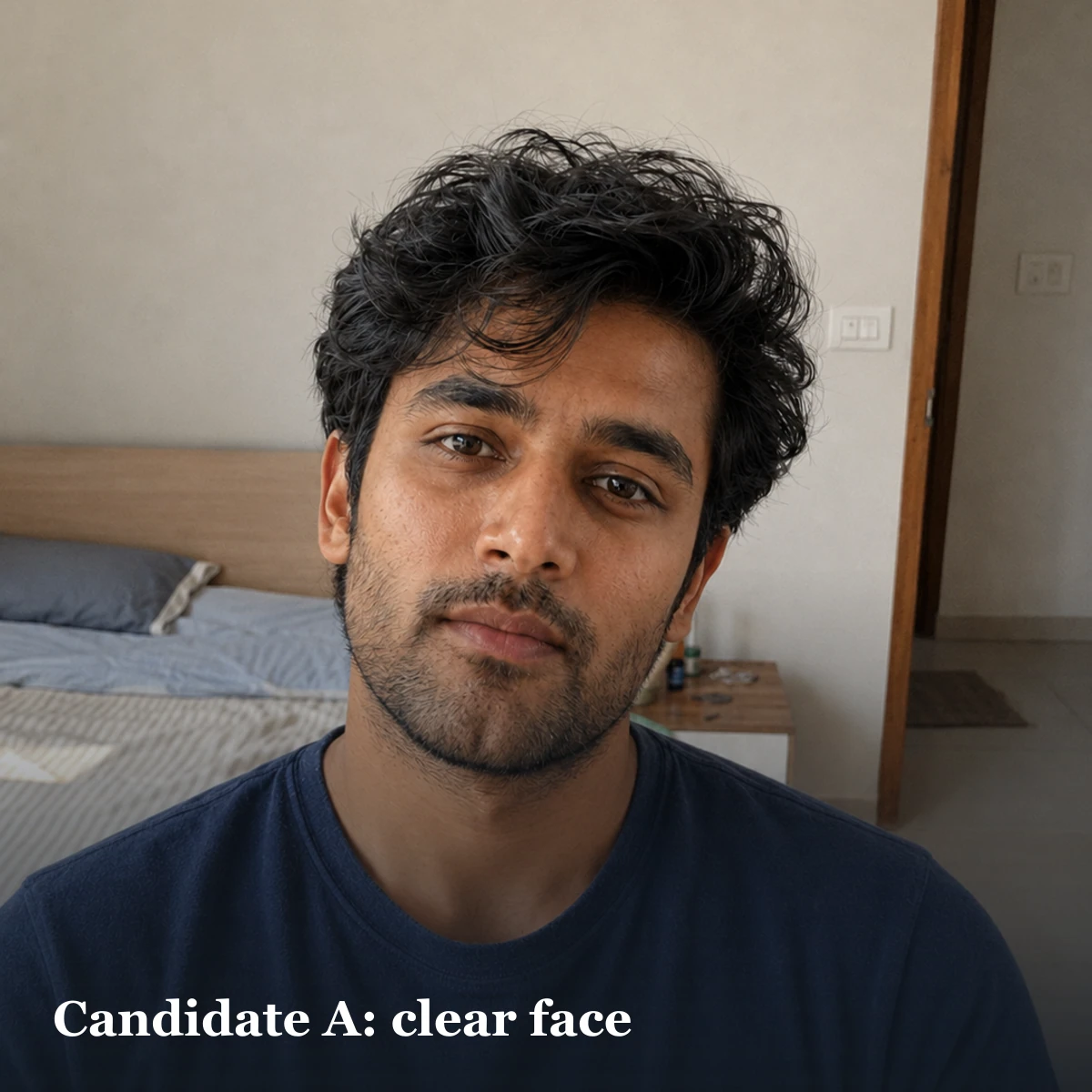
What the research supports, and what it does not
In two online studies with 610 participants, White, Sutherland and Burton found that unfamiliar people selected profile images that produced more favourable first impressions than the subjects' own selections. The experiments modelled profile image choice across social contexts. They did not test current Tinder, Hinge or Bumble distribution, live match rates, conversations or dates.
A qualitative analysis of 524 Tinder profile pictures collected in one northern German city in 2017 and 2020 identified several self-presentation types, including person-centred portraits and more concealed presentations. It helps explain how one image communicates identity, but it does not rank photo types or show which one causes better dating outcomes.
The practical conclusion is narrower than most commercial blog claims: another person can be useful for breaking a self-selection tie, and a clear solo portrait is easier to evaluate as an identity image. No reviewed study proves that one opener style works best for every man.
What should not be first?
Do not lead with a group photograph, distant full-body frame, childhood photo, heavy filter, or an image dominated by a car, pet or landmark. A helmet or sunglasses may be honest in an activity photo later, but they usually weaken the first slot because they conceal identity. A selfie is not automatically rejected: keep it only if it is current, natural, distortion-free, crop-safe and stronger than the rear-camera alternatives.
A generated or heavily enhanced first image has the same truth burden. If a friend who knows you hesitates to recognise the face, or the scene implies an event that never happened, it fails even when the file looks polished. Use the AI dating-photo authenticity guide before uploading it.
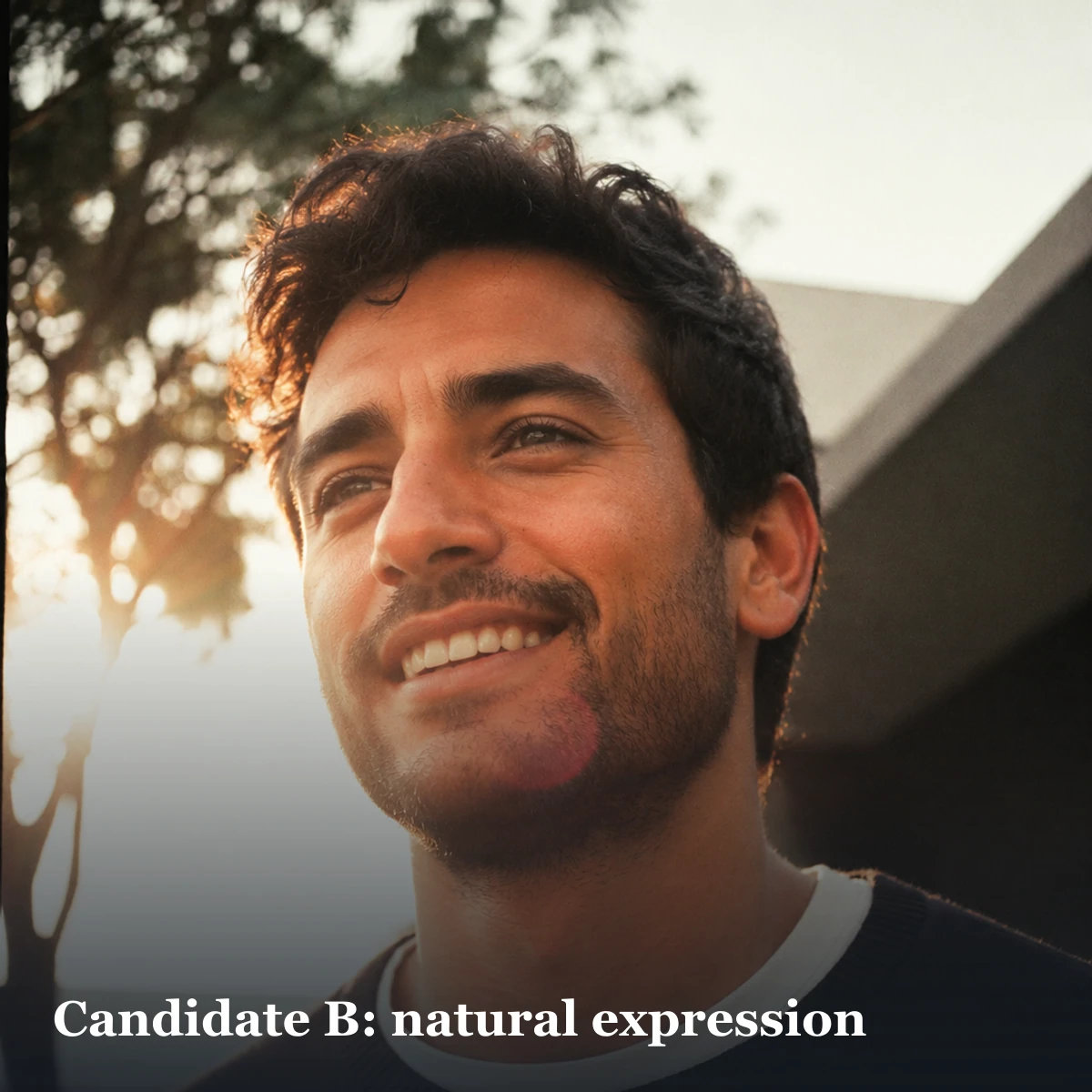
Build the rest of the set around the opener
Once the opener establishes identity, later frames can add a current full-body view, ordinary setting, real activity, consented social context and one dressed occasion. Each should answer a new question rather than repeat the same face, outfit and background. The complete dating-profile photo guide assigns those roles, and the photo-count guide explains why useful coverage matters more than filling every slot.
Edge cases the chooser must not erase
Recognition does not require removing the parts of your appearance that are normal in real life. Keep prescription glasses, a turban, hearing aids, facial hair, religious clothing or mobility equipment when they are current. The test is whether the frame represents how a date would recognise you now. Removing a normal feature to make a supposedly cleaner portrait can reduce truth rather than improve the photo.
Portrait mode is also not automatically better. Inspect hair, ears, glasses and shoulders for broken blur masks. A plain rear-camera photograph with accurate edges is safer than a dramatic synthetic-looking cut-out. If your appearance changes between clean-shaven and bearded, lead with the version closest to today and use the other only if the difference is still current and not confusing.
Record the decision so you can learn
Save the two finalists and the reasons one won. Change only the opener for a measured period while keeping prompts, location and preferences stable. Note profile visits and conversation quality if the app exposes them, but do not call a short-term change proof that the photo caused it. Visibility, seasonality and app activity move at the same time.
Sources and method
Matchframe compared current first-party app guidance with open-access research, then separated product features, observed findings and editorial advice. Sources were rechecked 4 September 2026.
- Bumble profile-photo upload guide, updated 7 September 2026 and checked 9 September 2026.
- Bumble: photo feedback, updated 8 September 2026 and checked 9 September 2026.
- Tinder: Photo Selector, updated 7 August 2026 and checked 9 September 2026.
- Hinge: Top Photo, updated 29 June 2026.
- White, Sutherland and Burton: Choosing face, open-access profile-image selection study.
- Degen and Kleeberg-Niepage: Profiling the Self, open-access serial picture analysis.
Frequently asked questions
What should a man's first dating-app photo be?
A recent solo portrait with a clearly visible face, readable eyes, natural expression and enough room for the app crop.
Should a group photo be first?
No. A group photo makes identification slower and is better used later, if everyone shown has consented.
Can a selfie be my first dating-app photo?
Yes, if it is current, natural, distortion-free, clearly recognisable at card size and stronger than your other candidates. A selfie is not automatically good or bad.
Do men have to smile in their first dating photo?
No. Test a relaxed neutral expression, slight smile and natural full smile under comparable conditions. Choose the clear, familiar version rather than following one universal smile rule.
How can I choose between two first photos?
Preview both at the same phone-card size, reject any that fail recency, identity, truth or crop safety, then ask an independent person which survivor looks most recognisably like you today.
Should I turn on Hinge Top Photo or Bumble Best Photo?
You can test an app's ordering feature after every uploaded image is current, truthful and recognisable. Reordering cannot repair a weak or misleading candidate.
Can an AI-generated photo be first?
Only when it remains clearly recognisable, represents your current appearance and does not invent a misleading scene, body or event. Polish cannot compensate for a truth failure.
Start with a recognisable photo library
Matchframe creates varied results from one current identity; you choose which images pass the opener test.
Open MatchframeAlso worth reading
- Dating-profile photo mistakes men can fix
A repair-order audit instead of random tips - How many dating-profile photos do you need?
A role-based answer with current app requirements - Should men smile in dating photos?
A practical expression matrix without fake statistics - Group photos on dating apps
Consent, placement and privacy rules