Pet-photo guide
Dog photos on dating profiles: a truth-first decision guide
Use one dog photo only when the relationship is real, the animal is comfortable, your face stays clear and the frame adds information missing from the rest of the profile. If the honest explanation is "I borrowed this dog for the photo," leave it out.
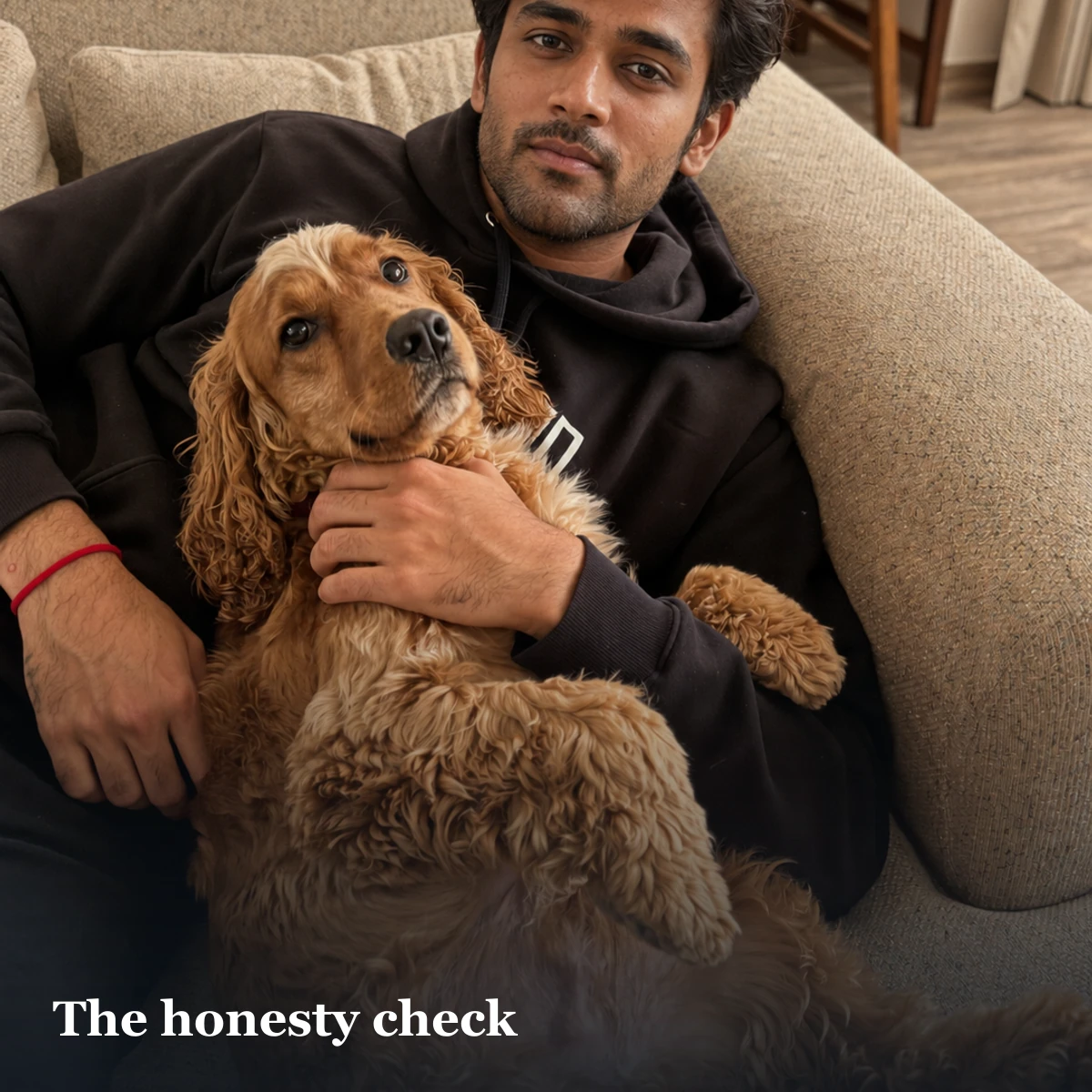
Keep, recapture or replace?
- Relationship is trueYou can explain whose dog it is without correcting the photograph.
- Permission and welfare passThe owner agrees and the dog stays comfortable.
- Your identity stays clearYour current face survives phone-card size.
- The frame adds one new roleIt does not repeat another routine, place or activity.
- Private details are safeTags, addresses, people and routine locations are cleared.
Decision rule: a failure in truth, permission or welfare means replace. Recapture only when the real moment is sound but identity, composition or privacy fails.
Choose one of four outcomes
| Outcome | Use it when | Next action |
|---|---|---|
| Keep | The relationship, welfare, identity, profile role and privacy all pass | Use one later in a varied lineup |
| Move | The image is truthful and clear but currently leads | Put a current solo face before it |
| Recapture | The relationship is real but the dog, crop, light or background fails | Photograph another calm moment from the same real routine |
| Replace | The relationship is implied falsely, permission is missing or the animal is uncomfortable | Use a truthful solo activity or everyday-life frame |
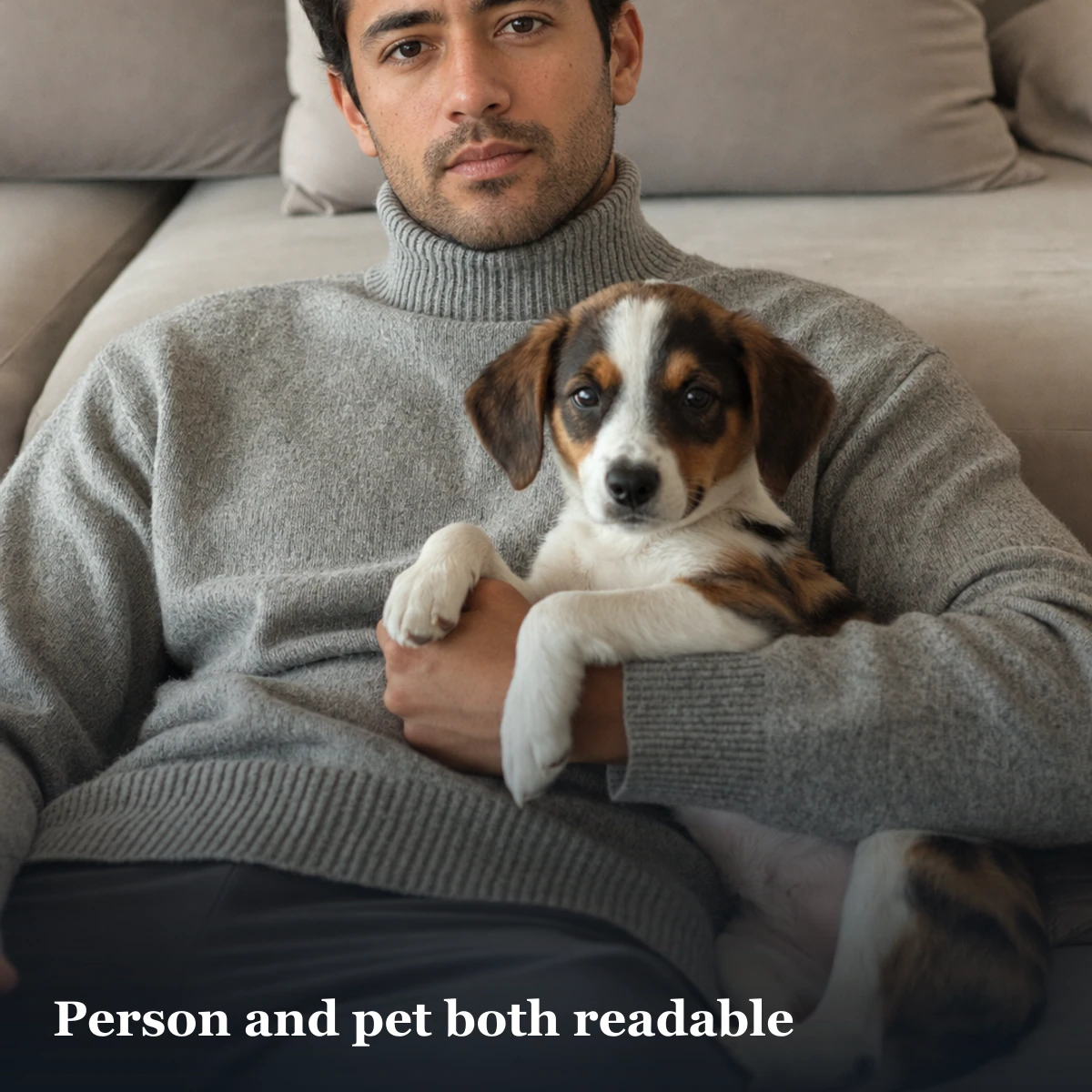
The five-gate dog-photo decision
| Gate | Pass | Fail |
|---|---|---|
| 1. Relationship | You own, live with, care for or regularly know the dog | The animal was borrowed to create an impression |
| 2. Permission and welfare | The owner agrees and the dog remains relaxed | The pose needs restraint, fear, unsafe food or forced handling |
| 3. Identity | Your current face is readable at phone-card size | The dog, sunglasses, distance or motion hides you |
| 4. New information | The frame adds a real routine or relationship | It repeats another outdoor, sofa or activity photo |
| 5. Privacy | Tags, addresses, gates, people and screens are safe to publish | The image reveals contact or location details |
Decision rule: relationship, permission and welfare are stop gates. A failure there means replace the photo, not edit it. Identity, role and privacy can sometimes be repaired with a different frame from the same real moment.
First define the relationship honestly
| Relationship | What the image may truthfully show | Decision |
|---|---|---|
| Your dog | A genuine current routine and responsibility | Keep if every other gate passes |
| Family dog | A real family relationship, not ownership | Keep only when the dog is genuinely part of your life |
| Friend's dog you know well | A limited relationship with the owner's permission | Use only if the honest explanation still makes the frame useful |
| Foster, rescue or work dog | The precise role and current involvement | Get the organisation's and owner's permission before public use |
| One-time encounter | Almost no dependable fact about daily life | Replace |
| Generated or composited dog | An event or relationship that did not happen | Replace |
Do not rely on “I will explain if someone asks.” A profile is already making an impression before a message exists. If a normal viewer would reasonably infer that the dog is yours or regularly in your life, the image should support that inference.
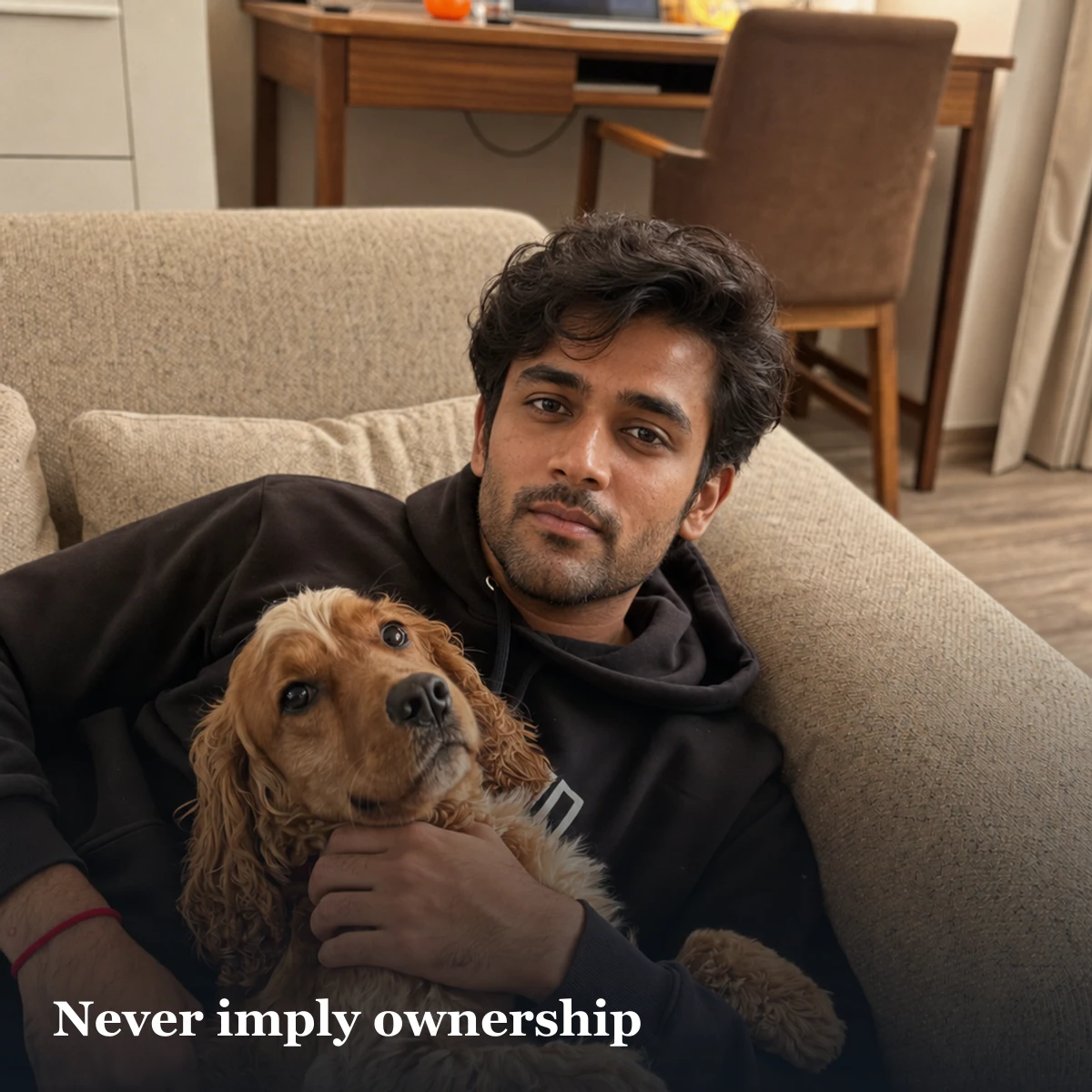
What Bumble currently says
Bumble's profile-photo guidance, updated 7 September 2026, lists a pet as one possible way to show what makes you distinctive and adds the condition “if it's yours.” The same page says photographs should show different aspects of the member and that the face should be clearly visible. This supports relationship truth, variety and identity clarity. It does not disclose a ranking boost, a required dog-photo slot or a guaranteed engagement effect.
Tinder and Hinge do not publish a universal dog-photo performance rule in the current first-party pages reviewed for this guide. Follow their current content and consent rules, but do not turn silence into an endorsement.
What the research actually tests
| Evidence | What happened | What it cannot prove |
|---|---|---|
| 2022 observational study | Researchers classified animal presentation in 2,400 dating profiles from Vienna and Tokyo; 15.5% contained at least one animal and dogs were the most common animal shown | It did not measure swipes, matches, messages, dates or causation |
| 2023 student proceeding | Three hundred participants used a mock dating app; preliminary analysis reported a selection effect for dog-present profiles among heterosexual participants | It was not a live platform, full paper or current Indian sample; the abstract said 2SLGBTQ+ analysis was still ongoing |
| Current app guidance | Bumble names a pet photo as one optional idea when the pet is yours | It is not experimental evidence or a hidden-algorithm disclosure |
The bounded conclusion is that animals are a recognisable profile element and can change selection in at least one preliminary mock setting. These sources do not justify promises about a 20%, 30% or 63% improvement, a best breed, a universal gender effect, or a fixed slot that works on every app.
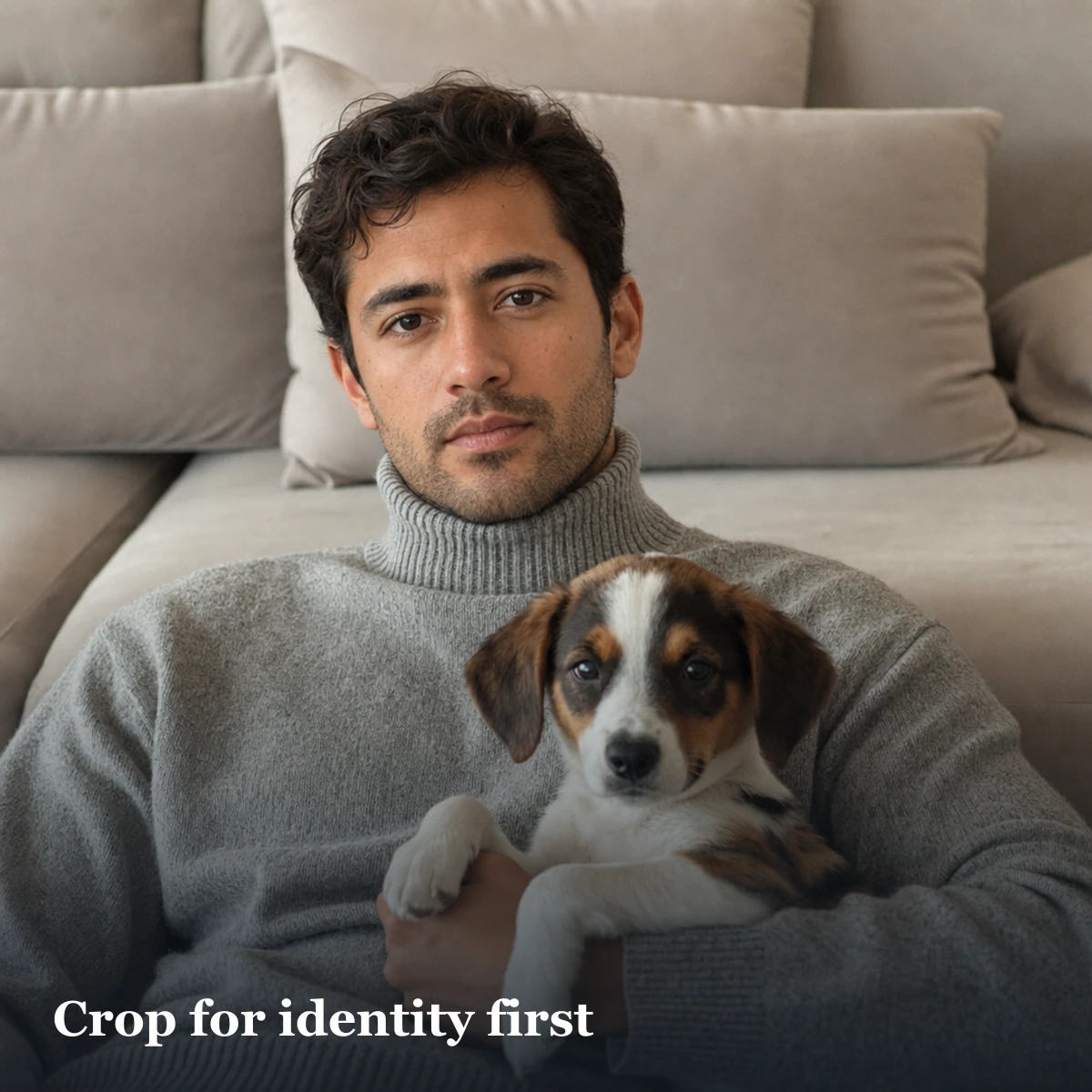
Why current competitor claims need caution
Five current commercial guides reviewed for this update agree on useful basics: show a genuine relationship, keep the person's face visible, use a natural moment and avoid filling the whole lineup with the dog. Several then make a larger leap, claiming that a pet proves warmth, responsibility or trustworthiness, or publishing match-rate percentages and fixed placement rules without a reproducible live-app method.
A photograph can invite those interpretations; it cannot certify a personality. Matchframe uses the useful composition advice while removing stereotypes, invented algorithm claims and unsupported outcome numbers.
Write the honest explanation before choosing the photo
- Your dog: "This is my dog, and this walk is part of our routine."
- Family dog: "This is my family's dog, whom I see most weekends."
- Friend's dog: "This is my friend's dog." Use the image only if that limited relationship is still worth showing.
- Volunteer or work setting: name the real role only when the organisation and owner permit public use.
- One-time encounter: the image adds no dependable fact about daily life; choose another role.
If the truthful sentence weakens the impression the photograph creates, the photograph is making a misleading claim. A realistic AI-generated dog does the same thing when that animal or routine never existed.
Choose the profile role before the camera angle
A pet photo can fill an everyday-life, activity or warm-detail role. It does not replace the clear solo opener or a current full-body view. Label every current photo by its one main job. If another frame already shows the same walk, park, sofa or relaxed-weekend idea more clearly, the dog photo is a duplicate rather than extra information.
Do not lock the image to an unsupported fixed-number placement rule. Put it after identity is established and before the set becomes repetitive. On apps that reorder photos automatically, recheck the visible order after enabling that feature.
Use one dog photo as a default, not a law
One strong frame is normally enough because a small dating profile has other jobs: a current opener, body-scale context, activity, everyday life and social or dressed context. A second animal image is justified only when it adds a different true role and the animal relationship genuinely shapes daily life. “One” is Matchframe's conservative lineup default, not a platform rule or measured match-rate optimum.
Remove the dog image temporarily and read the remaining lineup. Keep it when a meaningful, truthful fact disappears. Replace it when the profile becomes clearer and loses no important information.
Capture a real moment without using the dog as a prop
- Choose a familiar, low-stress place and keep normal safety equipment in use.
- Ask a friend to use the rear camera and take short bursts from a comfortable distance.
- Photograph an ordinary interaction: walking, sitting nearby, offering a familiar toy or calmly greeting.
- Keep the camera near the shared eye line without forcing the dog to be held or face the lens.
- Protect your eyes and facial outline from ears, fur, leash movement and motion blur.
- Stop when the animal turns away repeatedly, stiffens, hides or tries to leave.
- Review the frame at phone-card size, not only as a full-screen photograph.
A technically imperfect but calm, truthful frame is safer than a polished pose that required discomfort. Do not remove a harness, fabricate a park or change the animal to a more fashionable breed.
Animal welfare is a stop gate
VCA Animal Hospitals' veterinary guidance says stress signs depend on the dog and the situation. It lists behaviours including pacing or shaking, repeated yawning or licking, pinned ears, widened eyes, a tucked tail, rigid posture, avoidance, hiding and attempts to move away. A single frame cannot diagnose stress, but a photo session should not continue when discomfort is increasing.
- Use a familiar place, ordinary routine and the dog's normal equipment.
- Do not hold the animal in position, force eye contact or repeat a cue for the camera.
- Do not use unfamiliar food, unsafe objects or a busy setting only for visual effect.
- Stop when the dog avoids, freezes, stiffens, hides, growls or tries to leave.
- Ask the owner or handler to control the session when the dog is not yours.
This is not veterinary advice. If the dog's behaviour or health is a concern, stop the shoot and ask the owner or a qualified veterinarian rather than trying to obtain one more frame.
Test the frame at phone-card size
- View the image at the normal small card size without opening it.
- Confirm that your face is identifiable before the breed, leash or scenery.
- Check whether an ear, tongue, hand, sunglasses or motion blur covers key facial detail.
- View the complete lineup and name the one new fact the dog image adds.
- Move, recapture or replace it when identification or role depends on explanation.
A cute full-screen photograph can fail as a dating-profile image when the person becomes a background detail. Keep the dog's character, but do not make the reader search for the profile owner.
Run a privacy and consent scan
Get the animal owner's permission and permission from every identifiable person. Zoom into collar tags, phone numbers, address plates, vehicle plates, building names, work badges and screens. Replace or crop a frame that exposes a routine location. Current Tinder rules also restrict unaccompanied minors and publishing personal contact information, so a child-and-dog photo is not a casual substitute.
Permission to take the photograph is not automatically permission to use it on a public dating profile. If a photographer made the image, permission from the owner and people shown does not by itself settle copyright or licensing. Keep a written record of the intended public use when the image comes from a foster organisation, business, charity, client or professional photographer.
Handle difficult cases explicitly
| Case | Safer decision | Reason |
|---|---|---|
| Friend's photogenic dog | Replace unless it is a real recurring relationship and the owner agrees | The frame can imply ownership or routine |
| Foster or shelter dog | Use only with current organisational permission and an accurate role | Publicity, location and animal-status rules may apply |
| Service or assistance dog | Follow the handler's direction; do not stage interaction | The dog may be working and the relationship is not a prop |
| Deceased former pet | Use only if the image is current enough for your appearance and you are comfortable explaining the history | The relationship can be meaningful, but the photograph may imply a present routine |
| Dog-only photograph | Remove from the main lineup | A dating profile needs to identify the person |
| Child and dog | Replace | The child adds no necessary profile role and creates avoidable privacy and policy risk |
Do not invent the dog or the routine with AI
Do not add a dog, change its breed, manufacture a rescue or volunteer role, or place a real person in a walk, park or home routine that never happened. Do not use generative edits to make the animal look calmer, remove normal safety equipment or change the person's body, face, clothing, home or location.
A technical crop, modest exposure correction or removal of embedded metadata has a narrower purpose. It should not change who or what was present or what the moment means. Read the AI-photo authenticity guide when an edit crosses that boundary.
Use the dog as a conversation route, not proof of character
If the app supports a caption or prompt, one accurate detail can make the role clear: the dog's name, your real relationship, or the routine shown. Avoid claiming that the dog “approves” dates, that owning a pet proves kindness, or that someone who dislikes dogs is incompatible before the conversation begins.
The strongest conversation route is specific and answerable: a real walking trail, training task, foster role or ridiculous habit. It gives another person something to ask without turning the animal into a performance claim.
When the right answer is no dog photo
Replace the frame when the relationship is false, the dog looks uncomfortable, your face is unclear, permission is missing, private details cannot be removed or the set already contains the same lifestyle information. A solo walk, cafe portrait or real hobby frame can create an equally specific conversation route. Use the photo-role guide to identify the missing fact instead of following a pet-photo trend.
Final publish check
- The dog is genuinely part of your current life or the limited relationship is unmistakably honest.
- The owner and every identifiable person approved public dating-profile use.
- The dog remained comfortable and normal safety equipment stayed in place.
- Your current face is clear at card size and a solo opener appears first.
- The frame adds a distinct routine or relationship rather than repeating another role.
- Tags, addresses, number plates, screens, uniforms and routine locations are safe.
- You have the right to publish the file.
- No generated edit invents the animal, relationship, behaviour, place or event.
Passing this editorial check cannot guarantee moderation, distribution, matches, messages or dates. It only reduces misleading claims, welfare problems, identity confusion and avoidable privacy risk.
Sources, review method and limits
- Bumble profile photo guidance, updated 7 September 2026 and checked 9 September 2026; its example says a pet photo should be yours.
- Wanna See My Dog Pic?, a 2022 observational study of 2,400 profiles in Vienna and Tokyo; it describes presentation rather than outcomes.
- I "Woof" You, a 2023 student research proceeding reporting preliminary results from a 300-person mock-app experiment; it is not a live-platform result.
- VCA Animal Hospitals: Signs Your Dog Is Stressed, veterinary guidance updated 24 March 2025 and checked 10 September 2026; behaviour depends on the individual dog and context.
- Tinder Community Guidelines and Bumble Inauthentic Profiles guidance, checked 4 September 2026.
- Matchframe editorial method: official guidance and original studies outrank unsupported commercial percentages.
Frequently asked questions
Should I put my dog in my dating profile?
Yes, if the dog genuinely belongs in your life and the image adds true context after a clear solo opener.
Do dog photos get more matches?
No reviewed source proves a universal match-rate increase. One preliminary mock-app experiment found a selection effect among heterosexual participants, while a larger observational study did not measure outcomes.
Can I use a friend's dog in a dating photo?
Only when it is a real recurring relationship, the owner approves public dating-profile use and the photo does not imply ownership. If the honest explanation makes the image feel misleading, choose another photo.
Where should a dog photo go?
Use it after identity is established as an everyday, activity or warm-detail role. Do not rely on one fixed slot because apps and complete profile sets differ.
How many dog photos should a dating profile have?
Usually one is enough because each later photo should add a different fact. Use another only when animal care genuinely defines daily life and the frame adds a distinct role.
Can an AI dating photo include a dog?
Only when a narrow edit preserves the real animal, relationship and routine. Do not invent a pet, change the breed, manufacture calm behaviour or fabricate an activity that did not happen.
What if the dog will not pose?
Do not force the pose. Photograph a familiar calm interaction in short bursts, or use a different profile photo.
Should a dog photo be my first dating-profile photo?
No. Lead with a current solo face so identity is immediate, then use the dog photo later if it adds a truthful distinct role.
What dog stress signs should stop a photo session?
Stop when discomfort increases, including avoidance, hiding, freezing, rigid posture, a tucked tail, pinned ears, growling or attempts to leave. Ask the owner or a veterinarian when behaviour or health is a concern.
Can I use a photo from a shelter or foster programme?
Only with current permission from the organisation and owner, an accurate description of your role, and no exposed location, person or animal-status detail.
Create context that remains honest
Build varied scenes, then reject any image that implies a pet or lifestyle that is not yours.
Open MatchframeAlso worth reading
- How to crop dating-profile photos
A safe-area method without fragile pixel claims - Natural dating-photo backgrounds in India
Local light, privacy and plausibility checks - Ask a friend to take dating-profile photos
A copyable request and twenty-minute shot plan - Audit your dating-profile photos
A private keep, repair or replace decision tool